Before I take the wood to the band saw I start by making rough cuts with a circular saw. First I used my fine-tooth blade to cut a piece for the box back out of 3/8 inch plywood. This is my daughter helping me.
Next I rough cut my arch and pillar pieces. One 4ft by 4ft piece of plywood is enough to make two of these. My husband is watching from the other side to make sure I stop the cut in the right spot.
Once the pieces are rough cut, I can take them to the band saw and do the precision work.
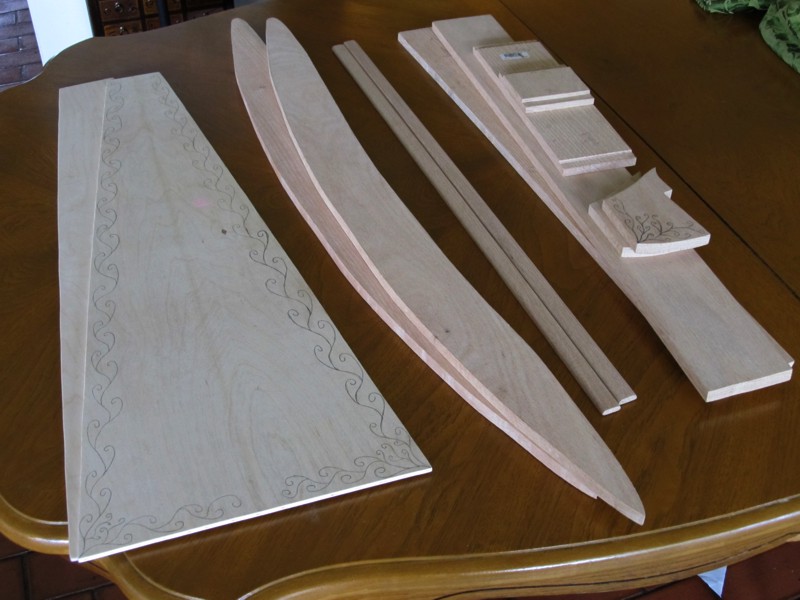
Believe it or not, here's all the wood, rough cut, that I need to make a harp:
Tuesday, August 6, 2013
Sunday, August 4, 2013
Harp No. 7
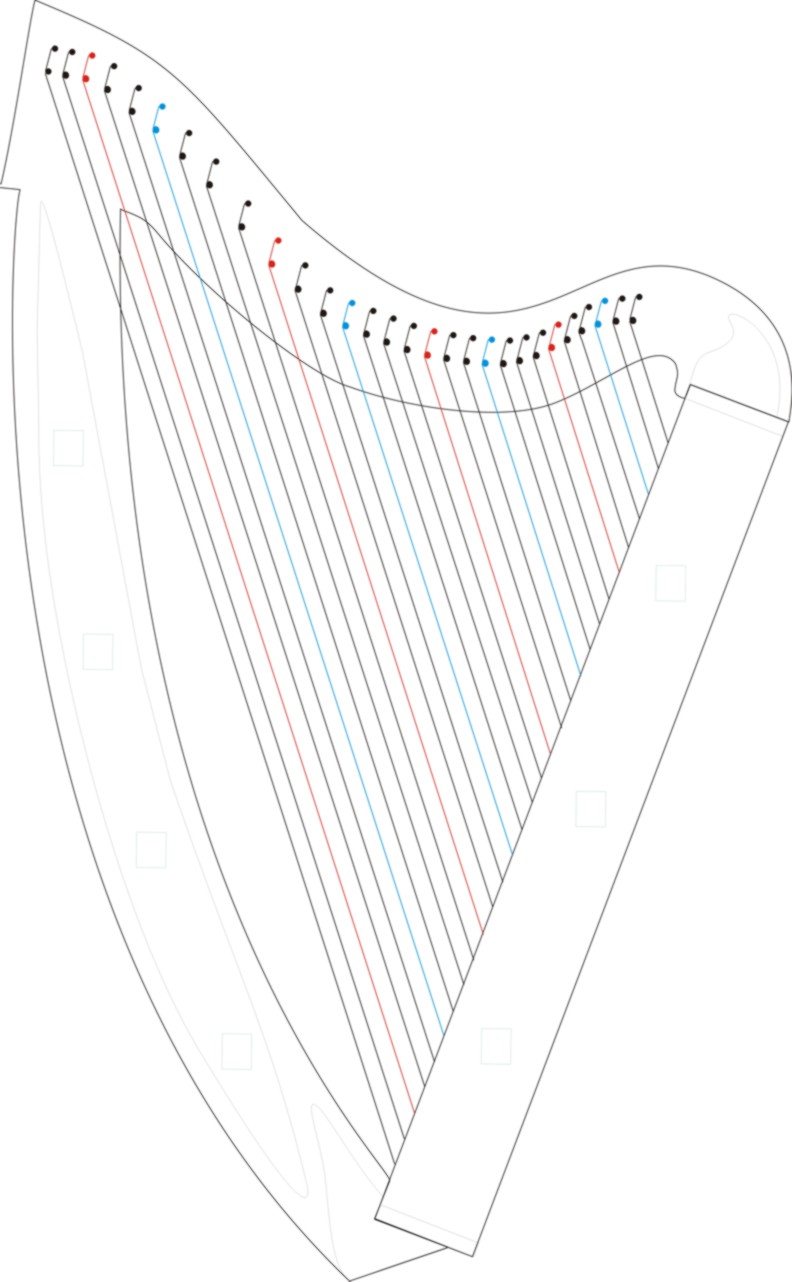
The first step in designing and building a harp is... designing it. This time I'm using the computer. Oh how I love those bezier curves. It's a snap to tweak it here and there until it looks just right. I also like being able to accurately space the strings, then with a click and a drag adjust their angle with the sound box until I like the shape of the harmonic curve along the top. Back when I did this by hand I had to re-draw everything if I wanted to try a different angle.
After I've got the design ready, I can print it out, actual size, on multiple sheets of paper. Then I tape it together and trace the arch and pillar onto my sheet of plywood.
I cleaned up the workshop today and should be ready to start cutting on Monday.
After I've got the design ready, I can print it out, actual size, on multiple sheets of paper. Then I tape it together and trace the arch and pillar onto my sheet of plywood.
I cleaned up the workshop today and should be ready to start cutting on Monday.
Monday, December 31, 2012
Harp Update
![]() |
| This is how it all looked at the beginning of the semester. |
This time, I was unexpectedly asked to teach two college classes when I thought I'd be taking a semester off, and this only a short while after I'd cut out all the pieces. I like having money, so I said yes to the teaching and let the harp pieces sit in the garage. When I had the chance on a weekend I'd steal a few hours to make some progress on the project. Forget setting up photos and then coming up with something witty to say about them on my blog.
![]() |
| We stained most of the pieces over Thanksgiving weekend. |
![]() | |
| Over Christmas break we finished the staining and I fitted the box. |
Labels:
harp
Tuesday, August 21, 2012
Harp in Progress
I spent the morning cutting out harp pieces.
This is me working on the design for the two brace pieces that go on the pillar.
I designed my harps to be easy to build. The only four power tools I use are a band saw, circular saw, drill press, and electric drill/screwdriver. Furthermore, I'm not a purist. I use screws to hold the box together. I also keep things simple by cutting the pillar and arch as a single piece, cut from one-inch plywood.
This plywood is bendy, which makes it very cooperative for fastening to the ends of the soundbox, but not so good at holding up under 1000 pounds of string tension. So I add brace pieces to either side of the curved pillar.
More photos to come as the project progresses.
Wednesday, July 25, 2012
Mr. Spock's Tips for Writers
I asked to borrow the book, and as I read it I learned that Nimoy now considers his previous title something of a mistake. He was only trying to be clever, not denounce his role as one of the best-loved science-fiction characters of all time. Nimoy cares deeply about the character of Mr. Spock, and has fiercely defended him against script writers and directors that just didn't understand the half-Vulcan, half-human Starfleet officer.
Which brings up two invaluable things I learned about storytelling as I read this book.
First of all, the audience will not always understand what you're trying to do. The title, I Am Not Spock, for instance. Fans were furious. It haunted Leonard Nimoy for years. In fact, he almost lost the chance to direct Star Trek IV because the producer erroneously thought Nimoy had written a whole book about how much he hated Spock. That's not what the book was about at all. Few had bothered to read it, apparently. They'd only looked at the title and jumped to a conclusion.
What to do? Beware ambiguity. When misunderstood, move on to your next project.
Sub-point: Being misunderstood can be agonizing, but it won't necessarily ruin your career.
Now for Mr. Spock's second tip for writers. This one is about character. It took a few episodes of the original Star Trek series for Leonard Nimoy to get a firm grasp on who Spock was, on what made him tick. But once he knew, he was ready to defend his concept of Spock. Time after time, a script-writer would come along who wanted to have Spock lose his temper, or be violent, or let down his Vulcan dignity in some other way, and Nimoy would have to go in and say, "I can't play this scene." He got some writers mad at him, especially since most of them had two other scripts to finish yesterday and they didn't want to re-write some scene for this pointy-eared alien. But because Nimoy insisted, and because Mr. Spock was so true to his character on the show, the fans responded. They loved him. They believed in him.
Know your characters. Then be willing to fight for them. Don't let anything compromise the integrity of their personality. If they wouldn't do something, it doesn't belong in the story. Rewrite!
Subpoint: Audiences love a character with a powerful internal conflict. But don't make the character constantly swing between one side and the other. That makes the character seem wishy-washy. Mr. Spock succeeds as a character because he almost always goes with his Vulcan side, though there are enough glimpses of the human side to let the audience know what a pressure-cooker is going on inside.
Thanks for the tips, Mr. Spock.
Wednesday, July 18, 2012
Technology and Fiction
I recently read a contemporary romance novel, Someone Else's Fairytale by E.M. Tippets, in which the college-aged characters were constantly video-chatting on their lap-top computers. If that book had been written ten years ago, it would have been science fiction.
It used to be that I could tell a book had been written in some previous decade by the technology alone. Now I can almost pinpoint the year. When reading World War Z, I could tell it was written before social media became a massive phenomenon. If there were zombies anywhere on the planet, my Facebook friends would totally have told me about it. World War Z Publication date? 2006. I thought so.
The world is changing so fast that if you write a piece of contemporary fiction, by the time it hits the shelves it's historical. Maybe this is a good thing. As author David Farland has pointed out, the biggest best-selling novels are stories that transport the reader to another time and place. Now it's nearly impossible not to transport your reader away from here and now. Even authors who write about now can't capture now fast enough. They're writing about then already. If you want to read about now, you have to go blog trawling.
Fortunately for me, I've never wanted to write about here and now.
Wednesday, July 11, 2012
Writers Club Wednesday: The Objective Correlative
“The only way of expressing emotion in the form
of art is by finding an "objective correlative"; in other words, a
set of objects, a situation, a chain of events which shall be the formula of
that particular emotion; such that when the external facts, which must
terminate in sensory experience, are given, the emotion is immediately evoked.”
--T.S. Eliot
We've all heard that, but HOW IS IT DONE?
When does tell become show?
George was nervous. (definitely telling)
George's heart pounded. (Sort of showing, but still mostly telling. I'm telling you his heart pounded. Why is that different from telling you he was nervous? It's even more ambiguous. Is he scared or excited?)
"Relax. This won't hurt a bit." The dentist held the drill poised over George's face. The drill motor whirred. George stared at the yellow-brown stain on the ceiling and wished he had paid for better dental insurance.
Now I don't need to tell you that George is nervous or that his heart is pounding. I've put you in his head and you're seeing things through his current emotional filter. He's noticing the drill in front of his nose, the sound of the motor, the stained ceiling. How does he feel? Mommy, get me out of this chair!
This is the objective correlative. You've got to choose what your characters notice based on how the characters are feeling at the time, then relate those things to the reader. Paint an emotional picture with objects, situations, and events. Give your reader the facts, and let the emotion come out on its own.
Here's your writing exercise. Get your notebook and write down four emotional states, spacing them out on the page. Then walk into another room in your house. Any room you like. Describe that room through each of your four emotional filters.
Happy writing!
Subscribe to:
Posts (Atom)