Friday, September 3, 2021

Star Fruit (Carambola) Jelly Recipe


Yesterday I saw on Facebook that one of my neighbors had a downed branch on their overloaded star fruit tree. The fruit had to be harvested right away. "Come and get it!" they said.

I love free fruit. Free fruit = jelly.

Before long I was trotting home with a large paper sack loaded with big, star-shaped, yellow and green fruits. I got out all my canning gear and was ready to get started.

Except guess what, I could not find a recipe for star fruit JELLY anywhere on the internet. There was jam. There was marmalade. No jelly. What?

Google, you've failed me!

Anyway, I decided to do some experiments and come up with a perfect star fruit jelly recipe of my very own. Here it is, in case you are ever blessed with a giant bag of unexpected star fruit:

Star Fruit Jelly - Makes 6 cups.

4 cups star fruit juice

2 Tbsp lemon juice

1 Tbsp lime juice

1.75 ounce package of powdered pectin (I used Sure-Jell)

6 cups of sugar


To get the juice I used a steam juicer. I washed the fruit, sliced it in 2-3 pieces, pulled out any obvious seeds, and filled up the steamer basket. After processing for an hour, I drained off enough juice for 2 batches of jelly. 

If you don't have a steam juicer, you can put the fruit in a pot, add some water and simmer for 30 minutes, then squeeze it all through a jelly bag. If you like that kind of punishment.

Trust me, just get a steam juicer. You'll thank me later.

Prepare enough jars to hold 6 cups of jelly, plus lids and bands. Wash them in hot, soapy water, rinse, and place on a rack in a simmering water bath canner to stay hot until ready to be filled.

Carefully measure 6 cups of sugar into a separate bowl.

Put 4 cups of star fruit juice, the lemon and lime juice, and the powdered pectin in a large pot. Stir until pectin is dissolved. Cook on high heat, stirring constantly, until it reaches a full, rolling boil. 

Add sugar. Continue to cook and stir until the mixture returns to a full, rolling boil. Boil for two minutes. Remove from heat. Skim off foam with a metal spoon.

Immediately ladle into hot jars, cover with lids, and screw on bands. Return full jars to the water bath canner. Add enough water to cover jars by 1-2 inches and bring to a gentle boil. Cover and boil for 5 minutes. Remove jars and place them on a towel on the counter to cool and set for 24 hours.

Enjoy!


Wednesday, June 6, 2018

Laie Summit Trail

A few months ago, my 16 year old son got the idea to take some friends and hike the Laie Summit Trail. I'd been to the falls several times and had seen the sign that points to the right for the falls and the left for the summit. Of course I wanted to see what was over in the other direction from the falls, and hiking to the top of the mountains that I can see out my front door every day? Awesome.

The first date we planned for the hike got rained out. Today we woke up to partly cloudy skies and a chance of rain. I could see the tops of the mountains, so we decided to go.

While looking around online I had a hard time finding something that told us exactly how long the hike would take. So here's the breakdown. We had two adults and three teenage boys on the hike. We all like hiking, but we're not avid hikers. People who are conditioned for 12 miles and 3600 feet of elevation could probably do it faster.

  • 9:00 AM - walked away from our front door
  • 9:15 AM - arrived at Cricket Field (closest place to park if you're driving)
  • 11:00 AM - reached the Laie Falls/Laie Trail sign at the fork
  • 12:30 PM - reached the summit
  • 1:00 PM - started down from the summit
  • 2:30 PM - reached the Laie Falls/Laie Trail sign again
  • 4:30 PM - reached the gate to the Laie Falls Trail
  • 4:50 PM - arrived home.
Walking from our house it was nearly an 8 hour hike. If we'd driven to Cricket Field, it would have taken 7.5 hours. 

Above Laie Falls we had to push through undergrowth, wade through mud, and jump over a few washed out sections. It was never hard to find the trail, though. I was glad I wore jeans and had a long-sleeved jacket. Once I stepped in a washed-out place that was hidden by ferns and sat right down on the trail with one leg hanging over a cliff. Just keep your eyes on the trail when you're moving and watch out for gaps and holes.

The forecast was for mostly cloudy with a chance of rain. As we got near the summit we climbed up into a cloud. It rained on us for only a few minutes, but that was enough to get us soaked and make it uncomfortably cold in the wind near the top. When we reached the summit and the ridge trail we went up the hill and found a nice spot to sit and eat lunch. While we were at the top it cleared off enough that we got a good view of Laie, and could also catch a glimpse of the surf on the Haleiwa side. We had cell phone coverage most of the way. I sent my daughter a text at the top, and also checked the weather radar and our exact location on google maps.

Next time I want to go when it hasn't rained for a week, and when the forecast is for clear skies. That should make the mud less and the view more.


Sunday, June 3, 2018

Our Experience with Adderall

Near the end of second grade, my youngest son was evaluated by the school district and we were told that he was high-functioning autistic. The specialist who gave me the news seemed to think she was doing us a favor. We could get accommodations now, she said.

One of those accommodations was special education. For certain school subjects, my son would be in a classroom with only a handful of other students. He would get specialized attention. This sounded like a good thing, since in his regular classroom his teachers often gave up on trying to engage him at all.

The first time I met with my son's fourth grade special education teacher, she asked me if I had considered putting him on medication.

"No," I said. There wasn't a medication for high-functioning autism. By then I'd had a year to read up about it, had been meeting with the school's autism specialist, and we had been making progress using Applied Behavior Analysis. I didn't see any need for medication.

The teacher proceeded to tell me the story of a boy she knew who had been put on a small dose of medicine and it had helped him so much in school. He had turned into a model student and was now in high school and you wouldn't know he'd ever had problems.

"I'm not interested in putting my son on medication," I told her.

She then told me that if I didn't do something about his behavior in school, my son would end up in remedial classes in middle school, with the "bad kids."

A little shocked to hear a special education teacher call students in remedial classes "bad kids," I dug in. I don't like being threatened. There was no way I was going to medicate my son. We were going to do this by patient effort alone.

And a lot of effort it was. Hours of sitting at his elbow repeating, "What's your next problem?" like a broken record. Day after day of turning away friends at the door, "He's not done with his homework yet." Assignments that should have taken him twenty minutes took two hours. And then they only took one hour. And then I didn't have to sit next to him. And then he could work downstairs with the rest of the family around him. We had come a long ways.

And then came middle school.

Our first semester of middle school was really hard work for both of us, but we did it, and did well. My son was in all honors classes, despite his fourth grade teacher's dire prediction, and he even got a 3.5 GPA his first semester. Still, it took a lot from me and from all of his teachers. Most days I had a phone call or an email about a behavior problem, usually because my son was not paying attention or not doing work in class.

When it came time for the annual IEP, one of his counselors, a woman who had really gone out of her way to help him, someone I'd come to really trust and appreciate, said, "All of his teachers say he has a hard time focusing in class. Have you considered putting him on medication?"

I looked around the table at those weary teachers, and felt the ache of exhaustion in my own bones. This was taking a lot out of all of us. "I don't even know where to start with that," I admitted.

"Just go see your regular doctor," she said.

So I did. Apologetically, I told the doctor I really didn't want to do this, but the school had suggested we try it. He didn't ask me any questions about my son or his behavior, just wrote out a prescription for Adderall, like it wasn't a big deal. We decided to start on the second to lowest possible dose. It almost scared me how easy that was.

We started the medication over spring break. On the second day of taking it, my son felt a little nauseated for part of the day, but it went away, and that was the only side effect we had. I noticed some differences immediately. I could ask him to do something that took more than one step, and he would complete the task without any further prompting from me. This was an entirely new and wonderful thing.

When school started up again after spring break, my son found it easier to focus in his classes and do his work in the mornings, but after lunch the medication would wear off. He could feel it when it happened. We raised the dose one notch, and after that he could get through the whole school day. I still had to monitor his school work and check up with his teachers somewhat, but he started getting more done in class and therefore had less to do at home. For several weeks things went very well. He liked being able to concentrate and get things done. I even thanked the counselor who had suggested the medication.

Then the inevitable happened. The medication stopped being as effective. Once again I found blank classwork in his folder and got notes from the teachers saying he had spent the class period doodling. "It just isn't working," my son said tearfully one evening as we struggled through an essay he had been too distracted to write in class. "At first the medicine was great, but now it doesn't help me any more. In fact, it's worse than before we started. I got used to it being easy, and now when it's hard, I can't do it."

"Do you want to try a higher dose?" I asked.

"No, I want to stop taking it," he said.

I didn't think he should stop when it was only three weeks to the end of school, so I suggested we just keep going until then. "If the medicine isn't working as well, it's up to you to try harder to focus. You know what it feels like to focus now, don't you? Can you do it on your own?"

He rubbed the tears away and told me he would try.

Things got better again. Grades that had dropped came up. Best of all, my son was learning to work with himself. One Saturday morning, I noticed the door to my walk-in closed was shut. I opened it to find my son sitting on the floor, working on a project for social studies. "I had to come in here so I could focus," he said. He was almost finished, and had done the project all on his own.

On Saturdays he doesn't take medication. He had found his own solution.

It's summer break now, and we're not planning to use Adderall again next school year. I think we've learned what we needed to learn from it. When my son was taking the medication his grades didn't go up. His personality didn't change. It only made things a little easier for me and for his teachers, and it made it easier for him to do his school work. He learned that he could focus, and began to find ways to do it on his own. For that, I'm grateful we gave it a try.


Sunday, December 24, 2017

Gingerbread Creations

When I lived in Nevada, every year for Christmas I made gingerbread creations like this one: 


And this one:


But then I moved to Hawaii. I love living in Hawaii, but it's humid. This is what happens to gingerbread creations in Hawaii:


It was going to be a clock tower with a candy face and a light inside the top, but it softened and collapsed within a few hours of being assembled. Darn humidity.

When I told my mom about this, she had a solution. She bought me a set of star-shaped cookie cutters for making a cookie tree. The cookie tree, she said, couldn't fall over because each cookie was stacked on the one below it. It was a Hawaii-proof gingerbread creation. So I tried it.


I still wanted to have candy windows, so I cut them out of the points of each of the larger stars.


The finished product looked like this. Not too bad.


But then it melted.


And melted some more.


That's Hawaii for you.

Over the next few years I tried different things. No more candy windows, but since a tree should be green I tried spreading each cookie with green frosting.


Most of the green ended up hidden between the cookies.

So the next year I tried dipping each cookie in green frosting.


That doesn't quite look the way I had envisioned it. It's all drippy.

This year I filled a decorating bag with green frosting and used a star tip. First I stacked up the cookies, using a ring of frosting between each one. Then I started at the bottom and piped the frosting onto the tips of each cookie star while my children put on the candies.


Now that's more like it!

Merry Christmas!


Saturday, May 7, 2016

Minecraft Feast (With Recipes)

For my son's 14th birthday he asked for a Minecraft party. All of his friends were coming over with their laptops and tablets so they could sit around and play Minecraft. This meant I didn't have to come up with party games, so I had plenty of energy to come up with a Minecraft feast.


My son and I looked at the Minecraft wiki and picked out a list of foods that he liked that weren't too hard to come up with:
  • Mushroom Stew 
  • Bread 
  • Golden (delicious) Apples 
  • Carrots (with greens still attached) 
  • Watermelon 
  • Pumpkin Pie 
I have to admit I was relieved my son asked for pumpkin pie instead of a cake. I could have tried to copy the exact look of a Minecraft cake, but it probably would have turned out like that Death Star cake my son's friend took for a sea slug at a previous birthday party.


When it came time for dinner at the Minecraft party, the party guests really got a kick out of the food. At first some of the boys were reluctant to try the mushroom stew, but those who did try it convinced the others to give it a go, and after that it was gone pretty quick.

If you'd like to create your own Minecraft feast for eight people, here's how to do it:

Purchase the supplies you need, such as the two pounds of fresh mushrooms, eight golden delicious apples, eight carrots with greens attached, and a medium-sized watermelon.

 Minecraft Bread (make a day ahead):

4 cups water
2 TBSP yeast
1/4 cup sugar
2 tsp salt
8 cups flour
4 TBSP butter, softened
additional flour

In a large bowl, put the 4 cups of water, 2 TBSP yeast, and 1/4 cup sugar. Let the yeast dissolve and begin to bubble. Add six cups of flour, the butter, and the salt. Stir until completely mixed. Add 2 more cups of flour to make a soft dough.

Sprinkle a clean surface generously with flour. Turn out the dough and knead for ten minutes, adding more flour if the dough gets sticky. Return the dough to the bowl, cover with a damp cloth, and let rise for about one hour, until doubled.

Punch down the dough. Divide it into eight equal pieces. Grease two large baking pans. Flatten each piece into a rectangle and roll up into an oval-shaped loaf, like the bread in the Minecraft game. Pinch the seams and the ends to seal. Place four loaves on each pan. Make three diagonal slashes in the top of each loaf. Cover with a damp cloth and let rise for about 30 minutes.

Preheat the oven to 375 degrees Fahrenheit. When the oven has finished heating, put the pans in. Bake for 20 minutes, or until the tops of the loaves are golden brown. Remove pans from oven. Remove loaves from pans and let cool on racks. Store at room temperature in air-tight bags or containers until ready to serve.

Pumpkin Pie

For the pumpkin pie, just use your favorite recipe or buy a pie from your grocery store bakery.

Minecraft Mushroom Stew (start about 1 1/2 hours ahead):

2 lbs fresh mushrooms
2 TBSP butter
2 cups chicken or beef stock
1 tsp thyme
2 cups milk or cream, or 1 15 oz can coconut milk
salt and pepper to taste

Wash and slice the mushrooms. Melt the butter in a large skillet. Add the sliced mushrooms and cook until the mushrooms are tender, about 20 minutes. Add the chicken stock and thyme and let simmer, uncovered, for another 20 minutes. Add milk or cream and season with salt and pepper to taste. Serve warm.

Apples, Carrots, Watermelon

While the stew is simmering, prepare the fresh fruits and vegetables.

My grocery store carries organic carrots with the greens still on. They taste fantastic, like fresh from the garden. Remove any badly wilted greens. Wash and peel the carrots without removing the tops.

Wash the golden delicious apples and place them in a bowl.

Wash the watermelon, then slice it longways into wedges.

Enjoy your feast!

Saturday, November 1, 2014

Pumpkin Casserole

My neighbors know I like pumpkin. Last year I told them I'd give them one bottle of home-made pumpkin pie filling if I could have their jack-o-lanterns when they were done with them on Halloween night.


This year I still have pie filling left from last year, so I didn't go pumpkin gathering. But I did take our own jack-o-lanterns and turn them into a different tasty treat. Pumpkin Casserole.

I wanted to get a picture when it was all pretty right out of the oven, but we ate it too fast.

Here's the recipe:

1 medium pumpkin (or two butternut squash), cooked, peeled, and mashed, about 4 cups
1 cup white sauce OR 1 can cream of chicken soup
1 cup diced ham
1/4 lb saltine crackers, coarsely crushed
1 cup shredded cheddar cheese (optional)

White Sauce:
2 Tbsp butter
2 Tbsp flour
1 cup milk
1 tsp salt
dash pepper

If you use a left-over jack-o-lantern, carefully scrape out any smoke spots or candle wax drips.

To cook the pumpkin I've used various methods. I've cut it up and put it in the crock pot. I've roasted it whole in the oven. This year I cut it in half and microwaved it, six minutes at a time, until it was tender and the peel came off easily. That didn't heat up the kitchen at all, which is very important in Hawaii, even in November! I always peel the pumpkin after I cook it. It's easier that way.

To make the white sauce, melt the butter in a saucepan. Add the flour and cook and stir until bubbly. Whisk in the milk and bring to a boil, stirring constantly. Add the salt, and pepper to taste.

Preheat the oven to 350 degrees F. Mix the white sauce with four cups of pumpkin, then stir in the diced ham. Spread the mixture in a 9x13 pan. Sprinkle the crackers on top and bake for 30 minutes.

Thursday, October 31, 2013

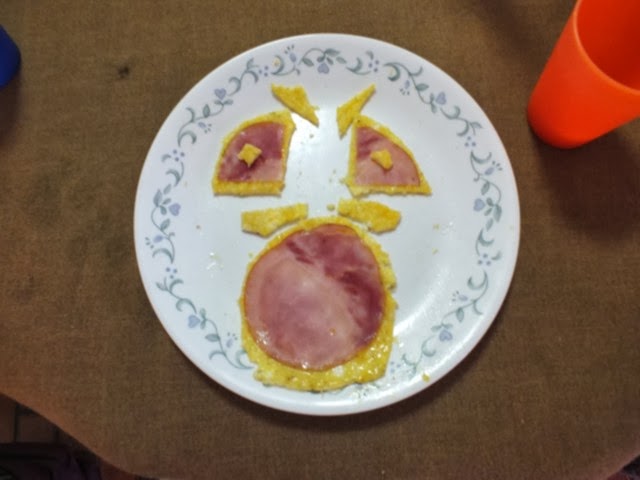
Halloween Ghost Omelets

I know most of you on the mainland had breakfast hours ago, but maybe you'd like to try this idea for next year:

GHOST OMELETS
 These are super fast and easy. All you need is:
  • Two eggs per person
  • One and a half circular-shaped slices of lunch meat per person. We used ham, but Canadian bacon, summer sausage, or even bologna would work.
  • Your favorite shredded cheese
  • Butter or margerine
  • Salt and pepper
Directions:

Melt a little butter in a round, flat skillet. Non-stick or well seasoned cast iron works best. Cut a half-circle of lunch meat into two eye pieces. Crack two eggs into a bowl. Add salt and pepper to taste. Whisk eggs with a fork, then pour them onto the hot skillet. Sprinkle with shredded cheese, then arrange eye pieces and a full circle of lunch meat for the mouth. Cook about 2 minutes or until the omelet is firm, using a lid to cover the skillet so that the top side will cook without flipping. Gently slide the cooked omelet onto a plate.
The kids can have even more fun once the ghost omlete is on their plate:
HAPPY HALLOWEEN!

Tuesday, August 6, 2013

Harp No. 7: Rough Cuts

Before I take the wood to the band saw I start by making rough cuts with a circular saw. First I used my fine-tooth blade to cut a piece for the box back out of 3/8 inch plywood. This is my daughter helping me.
Next I rough cut my arch and pillar pieces. One 4ft by 4ft piece of plywood is enough to make two of these. My husband is watching from the other side to make sure I stop the cut in the right spot.

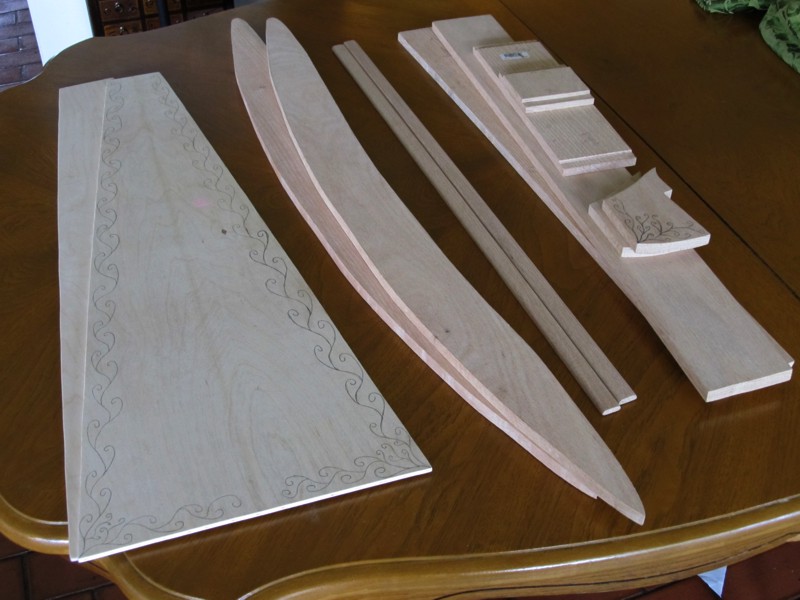
Once the pieces are rough cut, I can take them to the band saw and do the precision work.
Believe it or not, here's all the wood, rough cut, that I need to make a harp:


Sunday, August 4, 2013

Harp No. 7

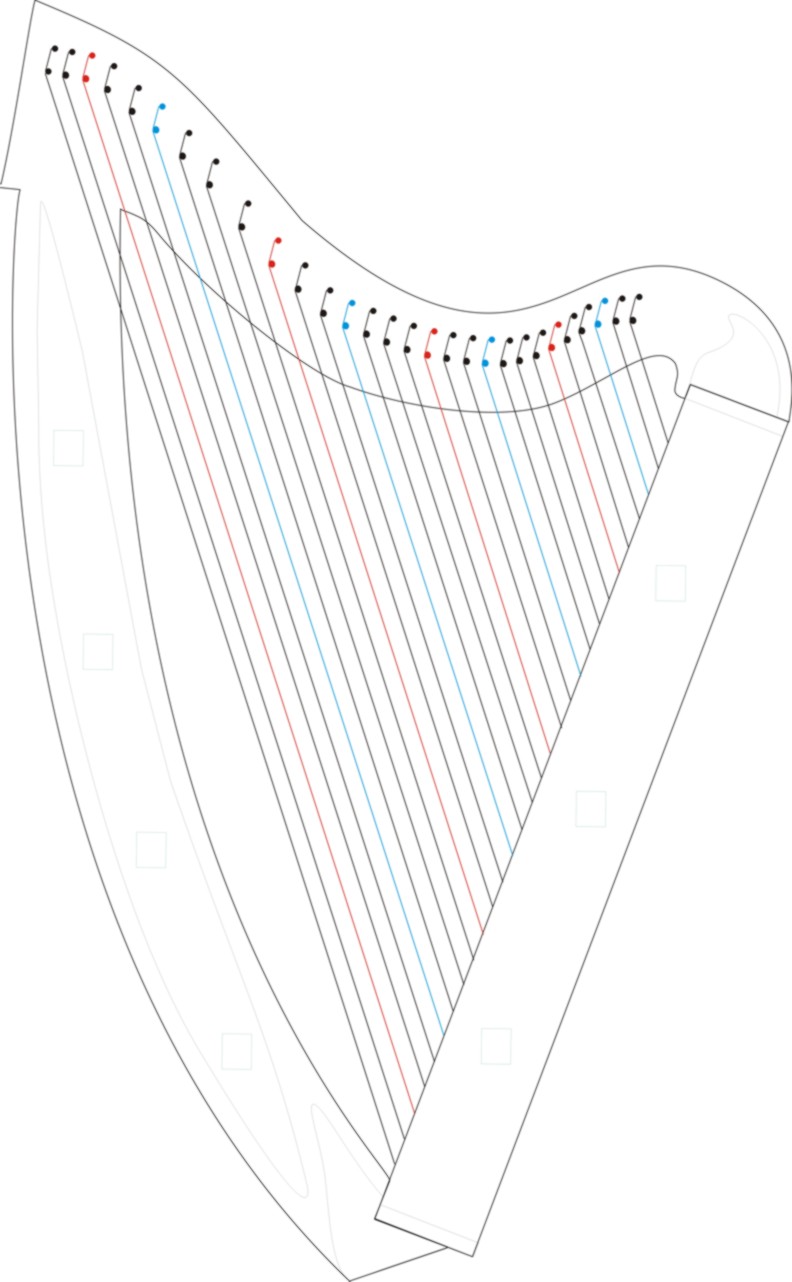
The first step in designing and building a harp is... designing it. This time I'm using the computer. Oh how I love those bezier curves. It's a snap to tweak it here and there until it looks just right. I also like being able to accurately space the strings, then with a click and a drag adjust their angle with the sound box until I like the shape of the harmonic curve along the top. Back when I did this by hand I had to re-draw everything if I wanted to try a different angle.
After I've got the design ready, I can print it out, actual size, on multiple sheets of paper. Then I tape it together and trace the arch and pillar onto my sheet of plywood.
I cleaned up the workshop today and should be ready to start cutting on Monday.


Monday, December 31, 2012

Harp Update

This is how it all looked at the beginning of the semester.
I keep thinking that I'm going to post instructions for how to build these harps, but then something happens. The first time, my husband got a job in Hawaii in the middle of a harp-building project, so I had to box up all the pieces in Nevada, send them half-way across the Pacific in a container, and then put them together six months later after they'd adjusted to the new humidity level. Needless to say, the blogging suffered.

This time, I was unexpectedly asked to teach two college classes when I thought I'd be taking a semester off, and this only a short while after I'd cut out all the pieces. I like having money, so I said yes to the teaching and let the harp pieces sit in the garage. When I had the chance on a weekend I'd steal a few hours to make some progress on the project. Forget setting up photos and then coming up with something witty to say about them on my blog.
We stained most of the pieces over Thanksgiving weekend.
But after having attempted to document this process on my blog several times, I think I've collected enough photos and notes that I can do a decent harp building page. I'll add it to my list of things to do in 2013.
Over Christmas break we finished the staining and I fitted the box.
Happy New Year, everyone!

Tuesday, August 21, 2012

Harp in Progress

I spent the morning cutting out harp pieces.

This is me working on the design for the two brace pieces that go on the pillar.

I designed my harps to be easy to build. The only four power tools I use are a band saw, circular saw, drill press, and electric drill/screwdriver. Furthermore, I'm not a purist. I use screws to hold the box together. I also keep things simple by cutting the pillar and arch as a single piece, cut from one-inch plywood.

This plywood is bendy, which makes it very cooperative for fastening to the ends of the soundbox, but not so good at holding up under 1000 pounds of string tension. So I add brace pieces to either side of the curved pillar.

More photos to come as the project progresses.


Wednesday, July 25, 2012

Mr. Spock's Tips for Writers

Last week, while over at a friend's house, I noticed the intriguing title, I Am Spock, on the spine of a book. Of course I'd heard of Leonard Nimoy's previous book, I Am Not Spock. Sure enough, this book was another Nimoy memoir, published twenty years after the first one. I wondered what had made him change his mind.

I asked to borrow the book, and as I read it I learned that Nimoy now considers his previous title something of a mistake. He was only trying to be clever, not denounce his role as one of the best-loved science-fiction characters of all time. Nimoy cares deeply about the character of Mr. Spock, and has fiercely defended him against script writers and directors that just didn't understand the half-Vulcan, half-human Starfleet officer.

Which brings up two invaluable things I learned about storytelling as I read this book.

First of all, the audience will not always understand what you're trying to do. The title, I Am Not Spock, for instance. Fans were furious. It haunted Leonard Nimoy for years. In fact, he almost lost the chance to direct Star Trek IV because the producer erroneously thought Nimoy had written a whole book about how much he hated Spock. That's not what the book was about at all. Few had bothered to read it, apparently. They'd only looked at the title and jumped to a conclusion.

What to do? Beware ambiguity. When misunderstood, move on to your next project.

Sub-point: Being misunderstood can be agonizing, but it won't necessarily ruin your career.

Now for Mr. Spock's second tip for writers. This one is about character. It took a  few episodes of the original Star Trek series for Leonard Nimoy to get a firm grasp on who Spock was, on what made him tick. But once he knew, he was ready to defend his concept of Spock. Time after time, a script-writer would come along who wanted to have Spock lose his temper, or be violent, or let down his Vulcan dignity in some other way, and Nimoy would have to go in and say, "I can't play this scene." He got some writers mad at him, especially since most of them had two other scripts to finish yesterday and they didn't want to re-write some scene for this pointy-eared alien. But because Nimoy insisted, and because Mr. Spock was so true to his character on the show, the fans responded. They loved him. They believed in him.

Know your characters. Then be willing to fight for them. Don't let anything compromise the integrity of their personality. If they wouldn't do something, it doesn't belong in the story. Rewrite!

Subpoint: Audiences love a character with a powerful internal conflict. But don't make the character constantly swing between one side and the other. That makes the character seem wishy-washy. Mr. Spock succeeds as a character because he almost always goes with his Vulcan side, though there are enough glimpses of the human side to let the audience know what a pressure-cooker is going on inside.

Thanks for the tips, Mr. Spock.


Wednesday, July 18, 2012

Technology and Fiction

I recently read a contemporary romance novel, Someone Else's Fairytale by E.M. Tippets, in which the college-aged characters were constantly video-chatting on their lap-top computers. If that book had been written ten years ago, it would have been science fiction.

It used to be that I could tell a book had been written in some previous decade by the technology alone. Now I can almost pinpoint the year. When reading World War Z, I could tell it was written before social media became a massive phenomenon. If there were zombies anywhere on the planet, my Facebook friends would totally have told me about it. World War Z Publication date? 2006. I thought so.

The world is changing so fast that if you write a piece of contemporary fiction, by the time it hits the shelves it's historical. Maybe this is a good thing. As author David Farland has pointed out, the biggest best-selling novels are stories that transport the reader to another time and place. Now it's nearly impossible not to transport your reader away from here and now. Even authors who write about now can't capture now fast enough. They're writing about then already. If you want to read about now, you have to go blog trawling.

Fortunately for me, I've never wanted to write about here and now.


Wednesday, July 11, 2012

Writers Club Wednesday: The Objective Correlative


“The only way of expressing emotion in the form of art is by finding an "objective correlative"; in other words, a set of objects, a situation, a chain of events which shall be the formula of that particular emotion; such that when the external facts, which must terminate in sensory experience, are given, the emotion is immediately evoked.”
    --T.S. Eliot

Translation: when it comes to emotion, SHOW DON'T TELL.

We've all heard that, but HOW IS IT DONE?

When does tell become show?

George was nervous. (definitely telling)

George's heart pounded. (Sort of showing, but still mostly telling. I'm telling you his heart pounded. Why is that different from telling you he was nervous? It's even more ambiguous. Is he scared or excited?)

"Relax. This won't hurt a bit." The dentist held the drill poised over George's face. The drill motor whirred. George stared at the yellow-brown stain on the ceiling and wished he had paid for better dental insurance.

Now I don't need to tell you that George is nervous or that his heart is pounding. I've put you in his head and you're seeing things through his current emotional filter. He's noticing the drill in front of his nose, the sound of the motor, the stained ceiling. How does he feel? Mommy, get me out of this chair!

This is the objective correlative. You've got to choose what your characters notice based on how the characters are feeling at the time, then relate those things to the reader. Paint an emotional picture with objects, situations, and events. Give your reader the facts, and let the emotion come out on its own.

Here's your writing exercise. Get your notebook and write down four emotional states, spacing them out on the page. Then walk into another room in your house. Any room you like. Describe that room through each of your four emotional filters.

Happy writing!


Sunday, July 8, 2012

Writing Exercise: Telephone Poem

At our last Laie Young Writers Club meeting, we did an exercise I learned from Tim Wynne-Jones at this year's Writing and Illustrating for Young Readers Workshop.

1. Write your phone number in a column down the left-hand side of the paper.
2. Write a poem. Each line has the same number of words as the telephone number. A zero is a wild card, you pick the number of words.

Here's my example (slightly altered so you don't know my phone number)

Waves leave lines in the sand
Delicate ridges
At the farthest reach of the water.
Rainbow foam
Sparkles and fades
Along traces
Like ridges
Of distant mountains
Etched momentarily
On the sandy canvas smoothed by the sea.

Saturday, June 30, 2012

What I Learned at WIFYR

Sorry I've been absent the last two weeks. I've been off island, in Utah, at the Writing and Illustrating for Young Readers Workshop. In a lot of ways, it was my best experience at the workshop that I've ever had. Here's the four most important things I learned this year:

1. Online Social Networking: It's not about you.

Elissa Cruz, one of the founders of the blog, From the Mixed-Up Files of Middle Grade Authors, gave a great lecture about building your online platform. The main thing I took away from it was that if you are online only to promote yourself, everyone will go away. It is not about you. Instead, think of yourself as part of a team where everyone can win if we help each other. Find the good stuff and share it.

2. Embrace the Delete Key

This one comes from Cynthia Leitich Smith. Apparently she's been known to write the first draft of a novel, then DELETE THE WHOLE THING. Now this sounds insane, until I remember that the less I've revised a piece, the better response I get from my test readers. So next time maybe instead of revising, I'll re-draft and see what happens.

3. Give Stories Time

I took a morning workshop class led by author Tim Wynne-Jones. One of the most valuable things I learned from him was to give stories time. Sometimes you have to leave a story in the drawer for years before you figure out what it needs, and then one day it comes to you. So that's when you pull it out, finish it up, and send it off.

4. Do Sound Checks Before Any Vocal Performance

With the agony still fresh in my mind, I'm not going to say anything more about this one.

But I do want to say a big THANK-YOU to all the authors, the editors, and the agent who so generously gave of their time and shared their knowledge with us at WIFYR. Best. Workshop. Ever.

Saturday, June 2, 2012

The Last Hukilau


There was a man who was the fisherman for the village. He wasn’t a fisherman like we think of today. Everyone in the village fished. The fisherman was THE BOSS. He had a huge net, yards and yards of panels twelve feet across. When it came time to fish, the fisherman would pile the net in canoes and take the men out to lay it all around the bay. Then he would go climb a tree and watch for the schools of fish to come in. 

A new e-mail popped up on my screen. Subject: Hukilau. I clicked on it.

Hey, lovelies!
Tomorrow, at 9:00 AM, there is going to be a hukilau at-you guessed it-Hukilau Beach. We're going to fish, and then I think cook the fish. And people have promised that we'll get at least one :)
So come!
Love y'all

The next morning I asked my children at breakfast, “Does anyone want to go to the hukilau?”

“NO!” they said. It was the first day of summer vacation, and they didn’t want to have to leave the house. At least not so early in the morning. We were going to a pot luck picnic at a different beach later in the day, and that would take them away from their computers long enough. I decided not to push it.

I went by myself.


When he saw the fish, he’d call for the villagers to come. Everyone ran down to the beach, men, women, and children.

There were other people on the sidewalk, moving toward the beach; a plump elderly couple in tourist clothes and sunhats, an athletic young woman with a blond pony tail, a red-haired man, his bare back nearly sunburned. A pick-up truck with its back end full of Polynesian kids passed me and turned into the beach parking lot.

The dirt-paved parking lot was packed with cars. A black tarp canopy, strung on aluminum poles, snapped in the wind. I hiked over the dunes and through round-leaved plants with purple flowers to reach the edge of the water. A cool wind blew spray off the ocean, mingled with spatters of rain from the gray clouds in the sky. People stood around a green rowboat, big Polynesians in t-shirts and swim trunks, stylish Japanese tourists in sun hats with shiny black cameras, children in blond curls chasing in and out of the water. Some of the men loaded fishnets made of thin nylon thread into the boat, making the boat look like it was filled with green mist.

When everything was ready, the men pushed the boat into the water. Swimmers with snorkels and fins followed, dark heads bobbing in the waves, as the man in the boat rowed out into the bay. With each pull of his oars, another length of net dropped into the water. After the net came a rope strung with long, brown leaves. The boat circled around and came back to land down the beach, where another group of people stood waiting to pull in the nets.
They would take up the ropes with leaves, lau, and pull on them, huki. Hence hukilau. Pull the leaves. The men would be out in the water, watching the net, to make sure it didn’t snag on any coral or rock.

Everyone on the beach grabbed the wet, sandy rope. People from all over the world; the woman with the blond pony-tail I’d seen on the way to the beach, next to a little Polynesian boy in a green tank-top, next to an old man with mutton-chop whiskers, next to a skinny Asian woman in a white blouse and pink shorts, next to me. We pulled, then stopped on signal for the swimmers to lift the net over the coral, then pulled again.

“Did you bring your kids?” asked one of my neighbors, the one who had sent me the e-mail.

“They didn’t want to come.”

“They only do this ever ten years. You’d think they’d want to see it.”

So the people pulled, and soon the nets would come up, flopping with fish. There would be more fish, and more, until the nets were full to bursting.


We walked the rope down the beach, pulling and winding it at the end, until the nets began to come up. Yards and yards of empty nets. I watched for the fish, wondering if we’d caught any at all. Something dark in one of the nets made my heart move a little faster, but it was only a bit of seaweed.

Slowly, panel by panel, the nets came out of the water. People lined up on either side of the nylon mesh, keeping it low to the sand, easing it along whenever the swimmers gave the signal. Out of the white surf came one small white shape. One lone fish, struggling in the net until his fins bled pink.

More and more net came up from the water, until the last panel broke from the waves. A scattering of fish twisted and shimmered as the divers stretched the net out on the sand. Children gathered close, everyone crouched around the net, working with their fingers to free the fish.

“They all babies,” said a Polynesian woman with a black-eyed toddler on her hip. She laughed. “Put them back in the water!"

When the catch was on the beach at last, everyone lined up. The children took their shirts and held them out at the bottom to make a basket. Each child got 3-4 fish, and adults would get ten or more. They would eat them raw, boil them, bake them, and dry the rest.
  

 A woman walked around with a mesh bag, collecting the fish. Children pinching silver fish about the size of an iphone ran to the water and rinsed them off, then put them in the bag. When all the fish had been collected, it wasn't enough to fill a three-gallon bucket.


"Can't schedule a hukilau, can you?" I asked one of the fishermen. "You have to wait until the fish come in."

He laughed. "This time of year the fish are still tiny. Every summer UH releases more fish out here, they have an orange tag on them, when you catch them you see it, it's really neat. But those are all gone by now. We didn't catch much today, but everyone had fun, yah?"

Special thanks to Uncle Joe Ah Quin for sharing his memories of the hukilau in old Laie Bay with the BYU Hawaii Women's Organization in October 2011. The historical details in this post were summarized from his words.

Sunday, May 27, 2012

Come Thou Fount

On Saturday, my son Daniel and I had our musical duo debut at his end-of-year violin recital. He's only been playing for one year, so I'm singing the praises of the Suzuki Method for enabling my son to quickly pick up this tune that I usually do with my Irish band, South Wind.

We've got a few kinks to work out. First of all, Daniel started playing the instant I had my harp on my lap, before I was really ready, so the camera didn't catch the first few notes and my music stand isn't quite where I'd like it to be. Second, I made the mistake of putting my hair up with a chopstick. Every time I turn my head to look at the sheet music, my hair is being yanked as my chopstick catches on the top of the harp.


I made it through in spite of it all, and Daniel did a wonderful job. A big thank-you to Daniel's teacher, Amy Gold, for all she does to promote music learning in our community, and also to Dr. Suzuki! Arigato Gozaimasu!

Thursday, May 24, 2012

Writers Club Wednesday: Anti-Heroes

Yesterday we had our first LIVE author visit from Steven L. Kent, journalist and author of a military sci-fi series, who shared some of his thoughts on anti-heroes. We talked about the advantages and disadvantages of making the bad guy the main character. Often, in a story, the villain is more interesting than the hero. So why not make him or her the protagonist? Some stories have done it and been successful, but most people like to identify themselves with a character who makes good choices rather than bad ones. Still, writing with anti-heroes can be a lot of fun.

For more on anti-heroes, let me direct you to the writing excuses podcast on the subject: http://www.writingexcuses.com/2009/12/20/writing-excuses-season-3-episode-29-antiheroes/
 
And I know I'm a day late on this, sorry Sue, but I'm still excited about the launch of the second book of the Mindjack trilogy, Closed Hearts. So in spite of play practice, creative writing homework, end-of-school-year music recitals, teenagers with last-minute Shakespeare projects, and all that jazz, here it is:


Announcing the release of Closed Hearts, the sequel to Open Minds by Susan Kaye Quinn.
Book Two of the Mindjack Trilogy
When you control minds, only your heart can be used against you.
Eight months ago, Kira Moore revealed to the mindreading world that mindjackers like herself were hidden in their midst. Now she wonders if telling the truth was the right choice after all. As wild rumors spread, a powerful anti-jacker politician capitalizes on mindreaders’ fears and strips jackers of their rights. While some jackers flee to Jackertown—a slum rife with jackworkers who trade mind control favors for cash—Kira and her family hide from the readers who fear her and jackers who hate her. But when a jacker Clan member makes Kira’s boyfriend Raf collapse in her arms, Kira is forced to save the people she loves by facing the thing she fears most: FBI agent Kestrel and his experimental torture chamber for jackers. Now available! $2.99 Ebook at Amazon (and Amazon UK) and Barnes and Noble Request a Kindlegraph Paper copies available at Amazon or get signed copies from the author
Susan Kaye Quinn is the author of the bestselling YA novel Open Minds,  Book One of the Mindjack Trilogy, available on AmazonBarnes and Noble, and iTunes. Susan's business card says "Author and Rocket Scientist," but she mostly plays on TwitterFacebook, and Pinterest.


Mind GamesOpen MindsClosed HeartsIn His EyesLife, Liberty, and PursuitFull Speed Ahead